

The LEAD Process: A Practical Framework for
Thinking More Clearly in a Noisy World
Four steps to optimized decision making
Listen
Gather information and perspectives first. Seek to understand fully before forming conclusions. Tune in to what's really being said, separating the signal from the noise.
LEAD depends on good questions and listening with full attention and open-minded intention to gather the information needed for optimal decision-making.
Evaluate
LEAD brings a process to the evaluation step. Weigh the facts. Challenge assumptions. Identify what is relevant. Determine what is really important to you. Ensure all the necessary facts are obtained so you can make the best decision.
If the decision warrants it, invest the time and effort in gathering the necessary data, and only then move forward.
Analyze
Identify the system behind the decision. Look at the full picture. What does this system want from you? What options do you really have?
LEAD helps you see beyond the immediate pressure. It gives you a clear process for sorting the thoughts, choices, and demands coming at you every day.
Decide
Choose the best available solution and commit to a clear course of action.
If the decision feels rushed or wrong, and if time allows, pause.
A delayed decision is sometimes the wiser decision.
Value your thinking highly. LEAD gives your decision-making structure, flexibility, and strength.

Who it's for
The 80% is < $175,700
The U.S. Census Bureau found that the bottom 80% of households had incomes up to about $175,700 in 2024.
The 80% is not a fringe group. It is the clear majority of American households.
When the 80% understands how systems work, they can ask better questions, think more clearly, and make better decisions,
When the 80% works together, they can claim a seat at the table where real change happens.

What it solves
LEAD clarifies thinking
Learn the power of process through a simple introduction to LEAD:
Listen.
Evaluate.
Analyze.
Decide.
LEAD gives people a process for slowing the noise, sorting the input into usable information, and making better judgments when decisions matter most.
It was designed to be used in real life, in real time, by the 80%.

Why it's needed
It's a noisy world
Humans were not designed to process input from this many systems at once.
The human brain is amazing, but today’s speed, volume, and uneven quality of information overload our attention, judgment, and analytical capacity.
LEAD provides a practical advantage in a world filled with systems competing for our time, energy, focus, and decisions.

Where it works
Identify the event cause
Many of the problems facing the 80% are systemic: healthcare, education, infrastructure, and many more.
Powerful organizations profit from confusion, frustration, and anger.
Many public arguments would improve quickly if we stopped treating every issue as a clash of personal opinions.
The 80% need to look beyond the latest event and examine the systems beneath it: the systems creating, rewarding, or perpetuating the problems that complicate our lives.
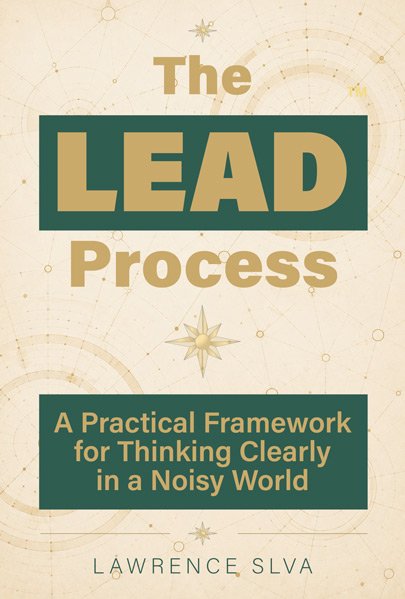
Available on Amazon

Why did I write the book?
Because I was tired of watching ordinary people get blamed for problems created by systems they did not design.
Too often, the 80% are told to work harder, be smarter, stay positive, make better choices, or take more personal responsibility, while the systems surrounding them remain confusing, inefficient, misaligned, and quietly stacked against them.
I do not believe every problem has a simple answer.
I do not believe one book can fix complicated systems-based problems.
I do believe people can be given better tools; but tools only work when they are used. And the tool needs to be easy to use, flexible, repeatable, and powerful.
The tool I designed is called The LEAD Process™: Listen. Evaluate. Analyze. Decide. It's my attempt to share a practical way of thinking that can help people slow down, ask better questions, understand systems more clearly, and make decisions with greater confidence.
I wrote this book both to help the 80% navigate the world as it is, and at the same time to begin the long process of imagining how it could work so much better for us all.