

Modern life is full of noise, pressure and competing demands.
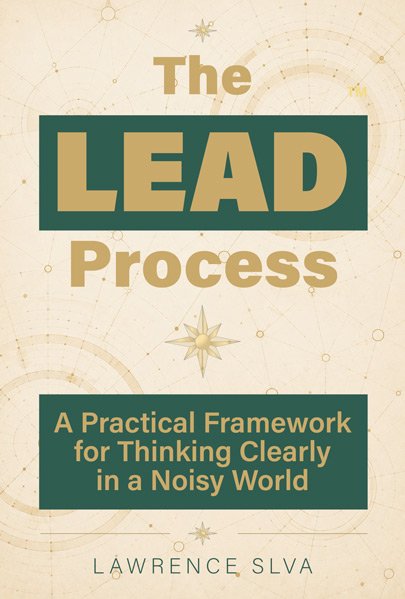
The LEAD Process provides a way to slow down, sort things out, and make clearer decisions.
What’s in the Book;
and Why It Matters
One goal of this book is to educate, but it was written to be conversational, practical, and easy to read. Just enough theory is provided to help readers use the LEAD framework in a wide variety of situations.
We cannot evaluate claims, systems, leaders, or solutions well if we do not understand the context around them. Once readers understand systems at a functional level, they can learn to look beneath the event causing a problem in their life and begin identifying the system conditions that helped produce it.
Instead of blaming individuals for outcomes they did not design, readers learn to identify inputs, incentives, stakeholders, feedback loops, burdens, tradeoffs, and missing problem definitions that more accurately explain a problem’s source.
To make LEAD as real as possible, the book applies the process to healthcare, education, election frameworks, and belief management. Along the way, examples and life experiences keep the tone real, grounded, and human.
Systemic problems become easier to discuss when we use shared language to move from problem definition to solution implementation.
Please invest in yourself. Read the book, practice the process, and build the kind of clarity noisy systems will deny you if given the chance.
Life after reading The LEAD Process
After reading The LEAD Process, the world starts to look different.
You begin seeing the systems under the events. A headline is no longer just a headline. A policy is no longer just a promise. A problem at work, home, school, or city hall is no longer just one person failing. You start looking for inputs, incentives, stakeholders, feedback loops, burdens, tradeoffs, and missing problem definitions.
Seeing system components becomes a habit. You start noticing patterns you used to miss. What once seemed random often starts to look like the predictable result of a poorly functioning system.
At first, LEAD takes effort. You have to slow down. You have to listen differently. You have to evaluate before reacting, analyze before judging, and decide with more care.
Over time, a shift occurs, and something changes internally. The process becomes easier. The questions become natural, and the noise quiets.
You become harder to manipulate, harder to rush, and harder to dismiss.
Once you begin seeing clearly, you will not want to go back.
Available on Amazon

About the Author
Lawrence Silva is a life-experienced business analyst, writer, and creator of The LEAD Process™.
After decades of working with systems, requirements, incentives, decisions, and unintended consequences, he began to see the same pattern almost everywhere: ordinary people were being blamed for problems they did not design, did not control, and could not reasonably solve on their own.
The LEAD Process grew out of that observation.
He writes for the broad group of working- and middle-class people he often refers to as “the 80%”. These are all the people who are for the most part just getting by, trying to make good decisions in a world shaped by systems that are often confusing, misaligned, and overwhelming.
His work is practical, nonpartisan, and process-oriented. He does not pretend life is simple. He does believe that clearer thinking, better questions, and more disciplined decision-making can help people navigate complicated systems — and, over time, help change them.
Reading, writing, taking pictures, watching movies, three margarita conversations, listening to vinyl, mountain bike rides, and eating great meals keep him busy, relatively healthy, and mostly happy.