

Better decisions begin with a better process
Practical solutions through careful listening, thoughtful evaluation,
solution-oriented analysis, and clarity-driven decisions

Who it can help
Solutions for adults & kids
Kids, and many adults, may be tech literate, but many have never been taught how to use a process to think clearly, make better decisions, and communicate with more confidence.
LEAD gives students the language to move from arguing about opinions to talking about solutions.
It works in class. It helps in life. And it really helps in job interviews.
Asking open-ended questions, listening with intent, then evaluating and analyzing before deciding how to respond is a game-changer.

How it works
Solution filter
LEAD filters incoming thoughts and opinions. It helps you interpret information from any source, at any point in your day.
Apply LEAD to your decisions, conversations, and challenges for greater clarity at home, at work, and in life.
That means fewer automatic reactions, fewer borrowed opinions, and more decisions you can actually stand behind.
Garbage in, Garbage out (GIGO) is a common systems term. Bad inputs lead to processing errors and correspondingly bad outputs.
Let LEAD become your Garbage-In filter, and keep your thinking clear and your decisions free from bad inputs and clouded thinking.

When it helps
See solutions clearly
Once you understand how systems work, you can apply process thinking to personal and professional decisions, conversations, and challenges.
Many problems today are not accidental. Some organizations make billions by creating confusion, sustaining dysfunction, or profiting from broken systems.
Identifying the systems underneath the problems is one of the first steps toward better belief management.

Why it works
See with a solutions lens
Once you understand the essence of systems, you begin to see the world differently.
Every system has incentives, and misalignment of purposes and goals often exists right alongside.
Many bad outcomes come from misaligned incentives, poor system structure, and unrealistic assumptions, not just difficult people.
LEAD separates the true problem from the noise created by an inefficient system.

When it works
The solution journey
LEAD helps you avoid adopting opinions just because they feel familiar, satisfying, popular, or easier to believe than to investigate.
Over time, LEAD becomes part of how you think. It helps you slow the reaction, test the input, and choose beliefs with more clarity.
Clearer thinking begins when belief becomes a decision, not a reflex.
LEAD gives you the tools to trust yourself to make the best decisions possible, minimizing the overload and maximizing your calm.

Where its useful
Healthcare solutions
LEAD works just as well with large systems like education and healthcare as it does with the smaller systems we interact with daily.
The scope and scale of systems like healthcare are challenging. That's what makes LEAD so useful. It's a tool to help level the playing field.
It's not that the people in healthcare are bad; it's just that they are on the side of the system, and not the 80%.
For systems large and small, process and structure matter most when they work together.
Real progress begins when people clearly define the actual problem, then use a process to move toward solutions rather than arguing past each other’s opinions.

How it scales
Civic solutions
Use LEAD to evaluate institutions, elections, and civic change with more clarity and less noise.
I designed civic frameworks that can improve outcomes for the 80% by shifting public conversation away from opinion battles and toward systems, solutions, and results.
In civic life, including issues that are as hotly debated as elections, LEAD provides a structured way to think, decide, and push for real change.
Once the 80% collectively work to change how candidates reduce noise in their communications, they can work to solve problems.
Real change can become not only possible, but an eventual systematic outcome.
How it's used
Solutions need design
Humans are complex creatures. Humans are also perfect examples of systems.
Groups of humans become larger, more complex systems.
When human behavior is combined with bureaucratic systems, complexity can grow quickly and create serious problems in our lives.
We are surrounded by systems we did not design.
Many of these systems do not function in our best interest. People say they are broken, but in reality, they are working exactly as designed.
It's only when we work together to change these systems can we substantially improve our lives.
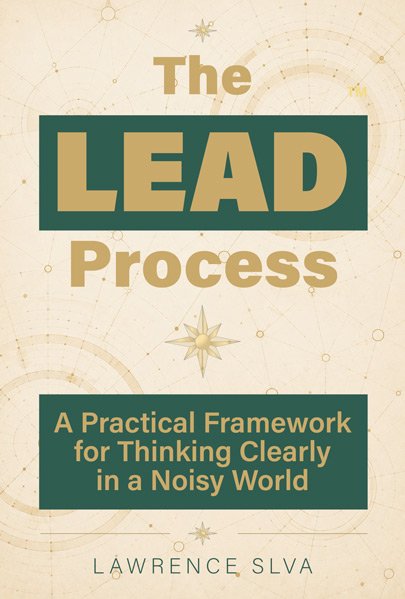
Available on Amazon
LEAD is the solution,
systems are the problem
For more than 99.9% of human history, people lived inside slow, local information systems. Today, many people live inside fast, global, commercialized, always-on information systems.
The human brain did not evolve for this volume, speed, or emotional intensity of input. Human brains are ancient systems trying to survive inside a brand-new information machine. This machine neither worries about us nor cares about us. It wants only what it was designed to want. It does only what it was designed to do, and it was not designed by us or for us.
Every system is a set of parts that interact to produce an outcome. Systems are composed of complex rules, layers of bureaucracy, and technology. They are complicated by profit motives, deadlines, and incentives.
When systems are unclear, confusing, or pressuring us for a decision, people often blame themselves for not understanding.
That’s where LEAD becomes useful.
Listen. Evaluate. Analyze. Decide.
Clearer beats faster.
And when life gets complicated, do not let your first reaction become your final decision. Make the decision to LEAD your life.